




We mainly perceive the sun’s rays through what we see on the skin’s surface: a tan, redness, age spots, or sunburn. However, we talk less about what’s happening deeper down—in the cells, in collagen, in elastin, and in the skin’s natural defense mechanisms.
And that’s exactly where the real sun-induced skin aging begins.
It’s not a process we see immediately after just one day in the sun. It’s silent, gradual, and cumulative. Every instance of excessive UV exposure leaves a mark on the skin. And over time, these marks begin to manifest as a loss of firmness, elasticity, hydration, radiance, and even skin tone.
The sun isn’t the enemy. The problem is excessive and unprotected exposure
Sunlight is a natural part of life. It affects our mood, daily rhythm, and vitamin D production. However, the problem arises when we expose our skin to UV radiation repeatedly, intensely, and without sufficient protection.
UV radiation contributes to so-called photoagingor premature skin aging caused by the sun. Scientific reviews describe UV radiation as one of the main external factors that accelerates skin aging through oxidative stress, inflammatory processes, DNA damage, and disruption of the collagen structure.
Simply put: chronic sun exposure doesn’t just affect skin color. It affects its architecture.
What happens in the skin after UV exposure?
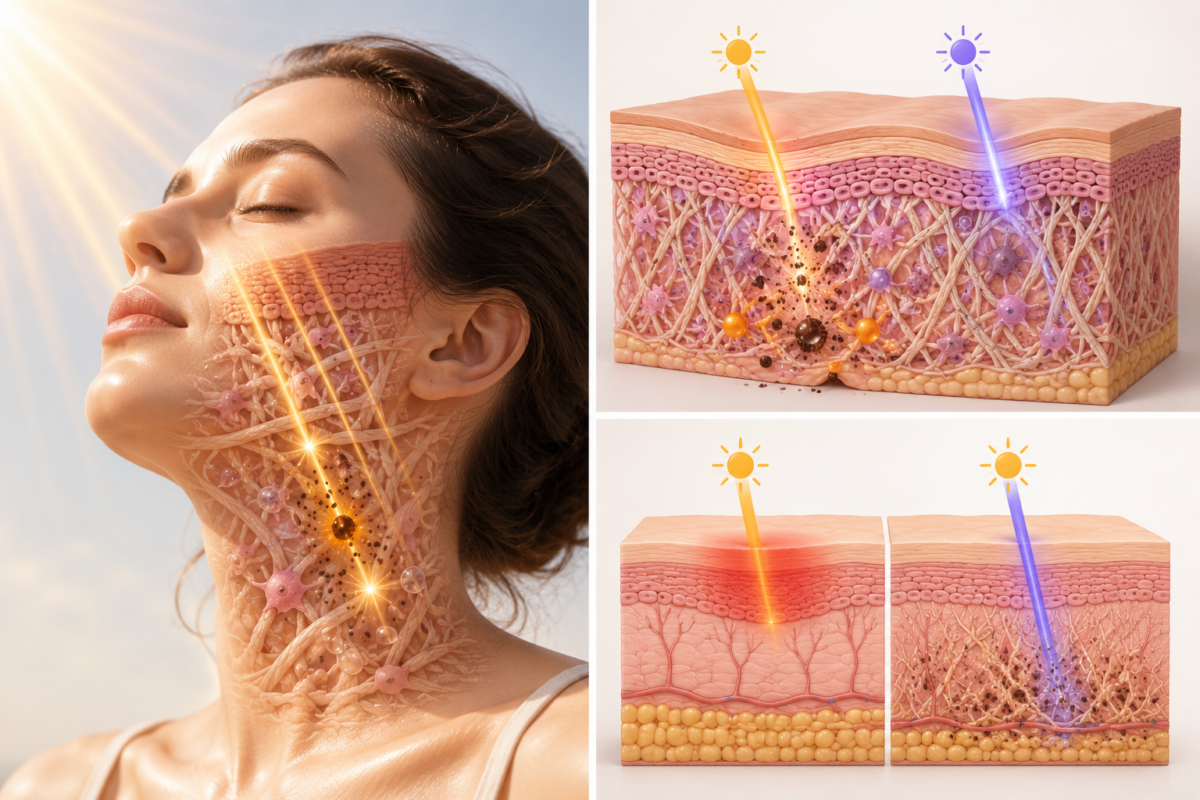
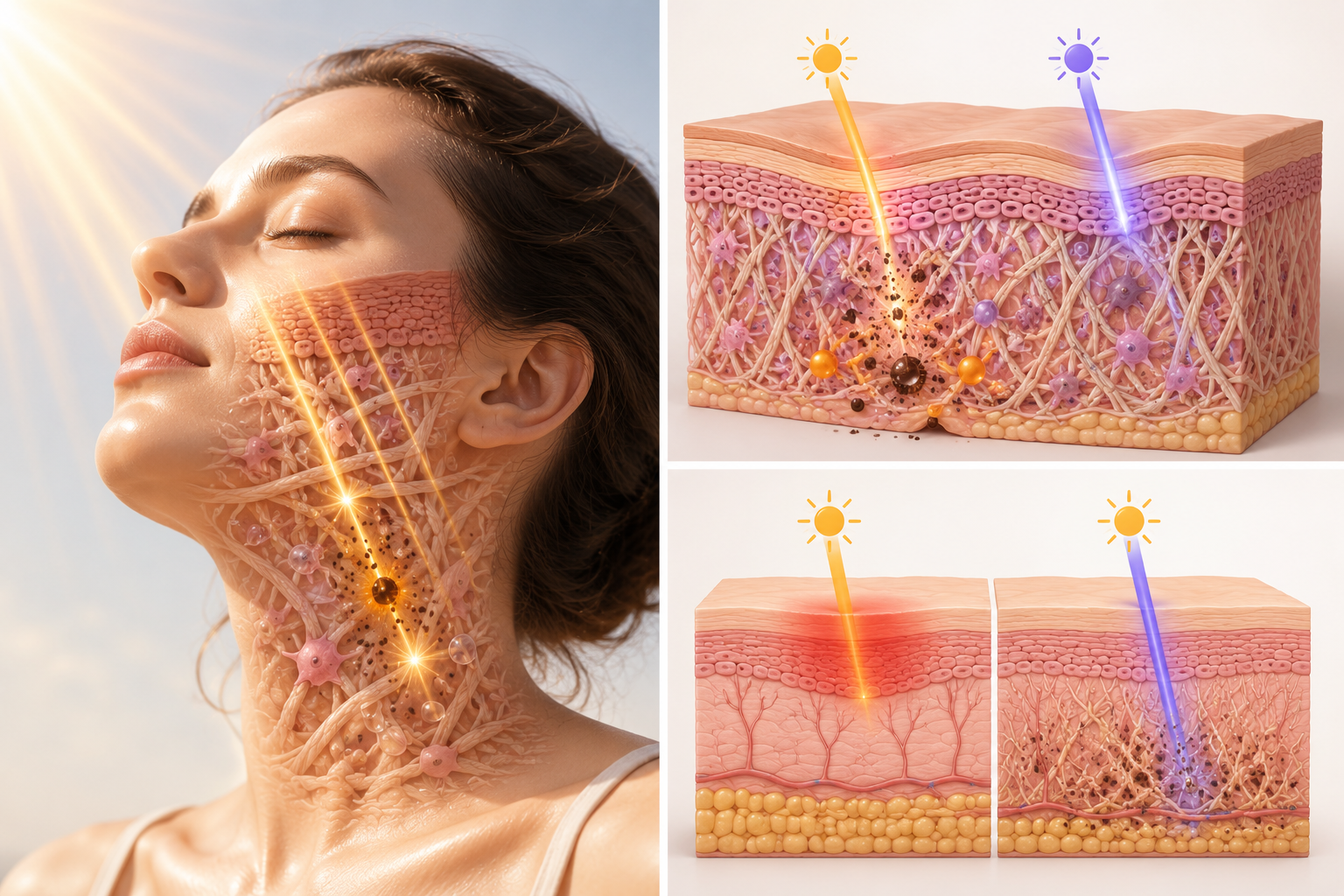
When UV radiation penetrates the skin, it triggers the formation of free radicals, technically known as reactive oxygen species (ROS). These are a natural part of metabolic processes, but when there is excessive exposure, a condition known as oxidative stress arises.
Oxidative stress is a problem because it can damage cell membranes, proteins, lipids, and DNA. In the skin, this manifests primarily through the activation of enzymes that break down the skin’s structural proteins—especially collagen. These enzymes are called matrix metalloproteinases, or MMPs for short. Chronic UV exposure promotes their activity and can simultaneously reduce the natural production of new collagen.
The result? The skin gradually loses its firmness, elasticity, and ability to maintain a smooth surface.

Collagen, Elastin, and the Extracellular Matrix: The Silent Architecture of Youthful Skin
I often use the analogy that the skin is not just a “wrapper.” It is living tissue with its own structure. This structure is primarily composed of collagen, elastin, hyaluronic acid, and other components of the extracellular matrix.
Collagen gives the skin its firmness. Elastin provides its elasticity. Hyaluronic acid and other matrix components help maintain hydration and volume.
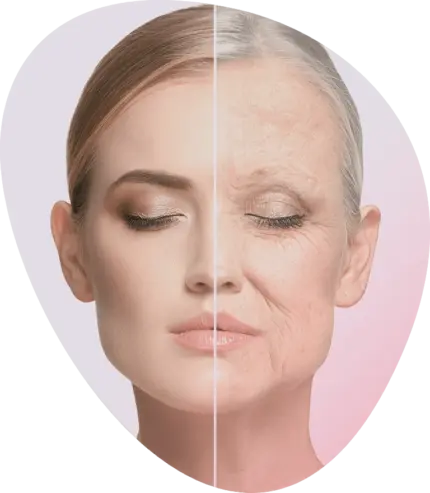
When UV radiation repeatedly damages this internal network, the skin changes. At first, the changes are subtle. Later, they become visible. Wrinkles appear, along with loss of contour, thinner skin, uneven pigmentation, and an overall tired appearance.
That’s why it’s important to understand that sun-induced skin aging isn’t just a matter of age spots. It’s a matter of tissue quality.
UVA and UVB: The Difference Matters
Most people associate UVB radiation with sunburn. It primarily affects the more superficial layers of the skin and is more intense on sunny days.
UVA radiation penetrates deeper into the skin and plays a significant role in long-term skin aging. It is present year-round, passes through clouds, and partially through glass as well. That’s why it’s not enough to think about protection only when on vacation at the beach. The skin is exposed to light exposure even during an ordinary day—while driving, walking, playing sports, working outdoors, or sitting by a window.
This is why professional organizations recommend using broad-spectrum protection against both UVA and UVB radiation and reapplying it regularly during extended outdoor exposure. The WHO recommends a broad-spectrum SPF of at least 30 and reapplication every two hours, especially after sweating, swimming, or exercising.
Why SPF Shouldn’t Be Viewed as Just a Seasonal Product
Many people use SPF only on vacation. But photoaging doesn’t occur only when tanning. It results primarily from repeated, everyday, and often underestimated exposure.
It is precisely these small, daily doses of UV radiation that can, over time, cause the skin to age faster than it needs to. Skin protection is therefore not just a summer topic. It’s part of long-term care for skin health.
SPF is the foundation. It’s not a cosmetic accessory, but the first line of defense against UV radiation. At the same time, however, we know that skin protection doesn’t end at the skin’s surface.
Internal protection: what do we mean by this?
When we talk about internal protection, we don’t mean a substitute for SPF. A dietary supplement cannot and should not replace sunscreen, a hat, sunglasses, shade, or sensible behavior in the sun.
Internal protection means supporting the skin’s natural mechanisms—particularly its antioxidant capacity, its ability to cope with oxidative stress, and its ability to maintain the structures that are important for skin firmness and vitality.
In recent years, the concept of nutricosmetics—that is, dietary supplements focused on the skin—has also been increasingly studied. Certain botanical combinations, such as extracts of rosemary and grapefruit, have been studied in relation to supporting the skin against UV-induced oxidative stress and signs of photoaging.
For me, this represents an important shift in thinking. We cannot view the skin in isolation. How it ages is related not only to what we apply to it, but also to the condition of its internal defense mechanisms.
Beauty Isn’t Just About Wrinkles
When we talk about skin aging, everything is often reduced to wrinkles. But mature, healthy, and well-cared-for skin isn’t skin without a single wrinkle. It’s skin that has good quality, comfort, hydration, elasticity, and an even tone.
The sun can significantly affect this quality. That’s why we shouldn’t just ask, “How can I avoid getting a tan?” or “How can I avoid getting sunburned?”
The more important question is: How can we protect the skin’s internal structure so that it retains its vitality for as long as possible?
My Perspective as the Founder of Skeeneffect
At Skeeneffect, we’ve long believed that skincare should be comprehensive. Not complicated.
This means understanding that a cream works on the surface and in the upper layers of the skin, while nutrients, antioxidants, and active ingredients taken internally can support the body’s natural processes. Not as a quick fix. Rather, as part of a long-term strategy for healthy aging.
When it comes to the sun, this is doubly true. It’s not enough to just deal with the consequences. We need to think preventively.
Protect the skin from UV radiation. Support it from within. Don’t forget about hydration, sleep, a healthy diet, and consistency. And above all, don’t view skincare as a vanity. It’s caring for the tissue that protects us every day.

Nutroxsun®: Internal Support for the Skin During Sun Exposure
In this context, the active ingredient Nutroxsun®which we use in the dietary supplement Natural Metabolic Health Ageless and in our Sun Bears—is also significant to us. Nutroxsun® is a patented botanical complex of extracts from rosemary and grapefruitdeveloped as part of the beauty from within that is, supporting skin quality from the inside. The manufacturer describes it as a clinically supported blend designed to preserve the skin’s collagen structure, elasticity, and natural luminosity.
Why is this particularly important when it comes to sun exposure? UV radiation in the skin increases the production of reactive oxygen species (ROS), which contribute to oxidative stress, inflammatory processes, and the degradation of the skin’s structural proteins. In a study published in the International Journal of Molecular Sciences Nutroxsun® was tested on UV-exposed skin cells and, in a clinical trial, on volunteers with skin phototypes I–III. The authors report that the botanical blend reduced UV-induced ROS and the pro-inflammatory interleukins IL-1, IL-6, and IL-8, while also reducing the secretion of MMP-1 and MMP-3—enzymes associated with the breakdown of collagen and elastin.
From a practical standpoint, it is particularly interesting that, in the clinical part of the study, Nutroxsun® doses led to a reduced erythema response following UV exposure and to faster skin recovery after sun exposure. The study also builds on an earlier two-month study involving 90 participants, which examined an increase in the minimal erythema dose, a reduction in lipid peroxidation following UVA/UVB exposure, and improvements in wrinkle parameters and skin elasticity.
That is precisely why we use it in Therefore, we view Nutroxsun® not as a “sunscreen in a capsule,” but asIt complements SPF, not replaces it. Sunscreen, sensible sun behavior, head coverings, and limiting intense exposure remain the foundation. Nutroxsun® complements this care from the inside—especially when we want to support the skin against daily light exposure, oxidative stress, and processes associated with photoaging.
That is precisely why we use it in Skeeneffect Ageless as part of long-term skin nutrition and in sun gummies as practical seasonal support for periods when the skin is exposed to more intense sunlight.
Conclusion
Sunlight may be pleasant, but it places a significant biological burden on the skin. Their effects aren’t limited to the surface. They affect cells, collagen, elastin, pigmentation, and the skin’s natural defense mechanisms.
That’s why modern skincare should be based on three pillars: sensible sun exposure, high-quality external protection, and internal support for the skin.
Not out of fear of the sun.
But out of respect for your own skin.
Modern sun protection is no longer just about what we apply to the skin. It’s also about how we support the skin’s natural defense mechanisms from within—with antioxidants, proper nutrition, and active ingredients that help the skin better cope with oxidative stress.